Battle of Flodden
The Constant PrincessThe Battle of Flodden is the decisive test of Katherine of Aragon’s military judgment during the Scottish invasion of 1513. Rather than risk the defense of England in a single engagement, she plans for retreat as well as victory, keeps a reserve force between the Scots and London, and advises Thomas Howard, Earl of Surrey, not to attack uphill. The news that James IV of Scotland has been killed turns that careful defense into a celebrated English victory—and establishes Katherine as a commander whose authority rests on preparation as much as courage.
Causes and strategic background
The battle belongs to a wider wartime effort in which Katherine had already helped direct English resources toward France. In 1512, while an English fleet sailed to join Ferdinand of Aragon’s campaign, she supervised the provisioning of ships, the stocking of armories, and the equipment of soldiers. Her experience of her mother’s work during her father’s campaigns had taught her that battles depended on reliable supply. She believed England could defend the Pope, defeat France, and secure gains through its alliance with Ferdinand, although members of the Privy Council feared another prolonged war.
The expedition’s disappointing course sharpened Katherine’s understanding of the risks of relying on an ally. English troops sent to Fuenterrabia waited without being committed to battle, while Ferdinand used their presence as a diversion and advanced into Navarre. When the English army returned in December, hungry, sick, mutinous, and diminished by two thousand deaths from illness, Katherine recognized that her father had misled her about his intentions. This earlier episode made the later Scottish campaign a test not only of military ability but of Katherine’s capacity to judge danger for herself.
Planning the defense
As the Scottish advance threatened the south, messages passed constantly between Katherine’s army and the force led by Surrey. Their plan gave Surrey the first opportunity to engage. If his force were defeated, Katherine’s army would meet the Scots farther south; if both forces were forced back, they had a further plan for defending London. They could summon a citizens’ army, raise earthworks around the city, and, if necessary, retreat to the Tower of London until Henry VIII returned from France with reinforcements.
Katherine refused to treat these stages as signs of expected failure. She had planned where to fall back and regroup, and where to fight again if necessary. Her reasoning was that one battle could not be allowed to open the road to the capital. She feared that a Scottish victory followed by a march down the Great North Road could threaten both London and the security of her crown. She kept her force in reserve because, as she understood it, the campaign’s purpose was to stop the Scots from sweeping south even if Surrey’s first engagement went badly.
The scale and visibility of her command mattered to the army as well as to the plans. Katherine’s forty thousand men followed the royal guard, carrying weapons and provisions; she rode at the head of the train on a white horse beneath the royal standard. Twice a day she rode along the line to encourage those marching at the rear. She maintained a strict religious routine, rising at dawn for Mass, taking Communion at noon, and praying at night for the realm and the king. By appearing in person, she made her leadership visible to troops who might otherwise have lost confidence in their defense.
The ground at Flodden
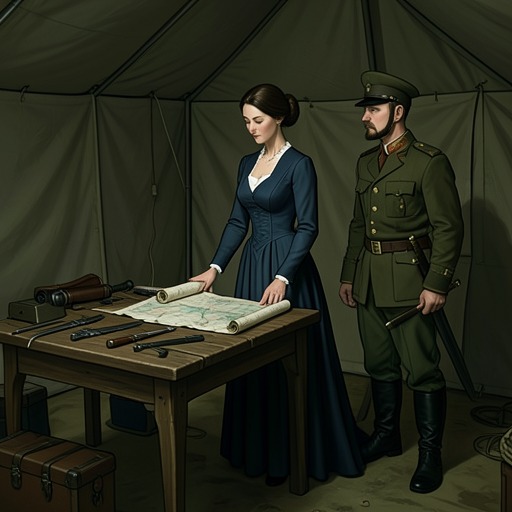
When Surrey reported that the Scots were encamped at Flodden on a strong ridge, Katherine studied his map. The Scottish position stood on high ground and commanded the view to the south. She concluded that an English assault uphill would expose the attackers to Scottish archers firing downhill and then to a charge by the Highlanders. The map, not an appetite for a glorious encounter, determined her advice: the Scots had to be drawn off the ridge or approached from the rear.
Katherine proposed that Surrey send spies to find a route around the Scots from the north. He could leave enough men in front to pin them down and move the rest as if heading north, hoping to draw the Scots onto open ground; otherwise, he might have to reach them from the north. The messenger noted that a stream on the sketch crossed boggy ground. Katherine still judged the northern approach the only available option, but distinguished her counsel from an order: Surrey, as the commander in the field, had to make his own judgment. She insisted only on the central tactical point that the Scots could not safely be attacked uphill.
Victory and its meaning
On 10 September 1513, a messenger from Surrey arrived at Katherine’s tent with news of the battle. He reported that the King of Scotland was dead, along with twenty Scottish lords and bishops, earls, and abbots. Katherine first lost color, then flushed as the report confirmed the victory. Surrey’s message credited the troops she had raised, trained, and armed, telling her that they had done what she ordered and that England was safe.
The messenger brought a bloodied and slashed surcoat taken from James IV’s body as proof, and said that the king’s body was being embalmed. Katherine immediately ordered a report to be dictated so that she could write to Henry VIII. The scene makes the victory both a military result and a matter of state communication: the ruler who had organized the defense must now establish what happened and inform the king. The story presents Flodden as the defeat of a major Scottish invasion and as the fulfillment of Katherine’s deliberate strategy, not as a triumph won by joining one reckless attack. Its emphasis falls on the relation between terrain, reserves, supply, visible leadership, and political survival.